df_f <- readRDS("data/items35_N1200.rds")
source('scr/rename_specific_items.R') # We decided to relabel some constructs for clarity
df_f <- rename_specific_items(df_f)
# F1 should be in Motivation, relabelled as M9
df_f$item_label[df_f$item_label=="F1"] <- "M9"Exp. 2 - Higher Order Structures
Load data
source('scr/CFA_items.R')Higher order structures
These analysyses correspond to section Reliability, discriminant validity and convergent validity of the scales in the manuscript.
First-Order Model (sub-constructs)
Let’s explore how the episodes operate via 12 sub-constructs.
set.seed(3110)

first_order <- "
# sub-factors: EDR
E =~ E1 + E6 + E7
D =~ D1 + D6 + D7
R =~ R1 + R3 + R7

# sub-factors: FM
M =~ M1 + M3 + M9
F =~ F3 + F6 + F10

# sub-factors: CB
G =~ G5 + G2 + G9
L =~ L5 + L6 + L7

# sub-factors: PEP
C =~ C2 + C3 + C6
X =~ X4 + X8 + X9

# sub-factors: AIA
S =~ S3 + S4 + S5
I =~ I1 + I2
B =~ B1 + B3 + B5
"

items <- c("E1","E6","E7","D1","D6","D7","R1","R3","R7","M1","M3","M9","F3","F6","F10","G5","G2","G9","L5","L6","L7","C2","C3","C6","X4","X8","X9","S3","S4","S5","I1","I2","B1","B3","B5")
tmp <- CFA_items(df_f,vignette = 1:12, items=items,vignette_name="ALL",bonusquestion="HAAS")
fit1 <- lavaan::cfa(model = first_order, data = tmp, meanstructure = TRUE,estimator = "MLR")
fit1.meas <- lavaan::fitMeasures(fit1,c("tli","chisq","df","pvalue", "cfi", "rmsea", "srmr"))
print(fit1.meas)
tli chisq df pvalue cfi rmsea srmr
0.949 1617.750 494.000 0.000 0.958 0.044 0.039 First and Second-Order Model
Let’s explore how the episodes (Constructs) operate when build as second-order model with sub-constructs.
set.seed(3110)

second_order <- "
# sub-factors: EDR
E =~ E1 + E6 + E7
D =~ D1 + D6 + D7
R =~ R1 + R3 + R7

# sub-factors: FM
M =~ M1 + M3 + M9
F =~ F3 + F6 + F10

# sub-factors: CB
G =~ G5 + G2 + G9
L =~ L5 + L6 + L7

# sub-factors: PEP
C =~ C2 + C3 + C6
X =~ X4 + X8 + X9

# sub-factors: AIA
S =~ S3 + S4 + S5
I =~ I1 + I2
B =~ B1 + B3 + B5

# 2nd order factors

EDR =~ E + D + R
FM =~ M + F
CB =~ G + L
PEP =~ C + X
AIA =~ S + I + B
"

items <- c("E1","E6","E7","D1","D6","D7","R1","R3","R7","M1","M3","M9","F3","F6","F10","G5","G2","G9","L5","L6","L7","C2","C3","C6","X4","X8","X9","S3","S4","S5","I1","I2","B1","B3","B5")

tmp <- CFA_items(df_f,vignette = 1:12, items=items,vignette_name="ALL",bonusquestion="HAAS")
fit2 <- lavaan::cfa(model = second_order, data = tmp, meanstructure = TRUE, estimator = "MLR")
Warning: lavaan->lav_object_post_check():
covariance matrix of latent variables is not positive definite ; use
lavInspect(fit, "cov.lv") to investigate.fit2.meas <- lavaan::fitMeasures(fit2,c("tli","chisq","df","pvalue", "cfi", "rmsea", "srmr"))
print(fit2.meas) tli chisq df pvalue cfi rmsea srmr
0.918 2512.255 538.000 0.000 0.926 0.055 0.060 Bi-factor Model
Test whether the items load on both a general factor and their specific episode factors (sub-constructs).
     tli    chisq       df   pvalue      cfi    rmsea     srmr
   0.901 2854.587  525.000    0.000    0.913    0.061    0.065
Second-order Model only
Test whether the items work through 5 constructs only (all sub-constructs are included in each construct).
     tli    chisq       df   pvalue      cfi    rmsea     srmr
   0.678 8516.714  550.000    0.000    0.702    0.110    0.100
First-order, Second-order and a Generic Third-order
Warning: lavaan->lav_object_post_check():
   some estimated lv variances are negative
tli chisq df pvalue cfi rmsea srmr
0.917 2561.692 543.000 0.000 0.925 0.056 0.062 Visualise Models
First-order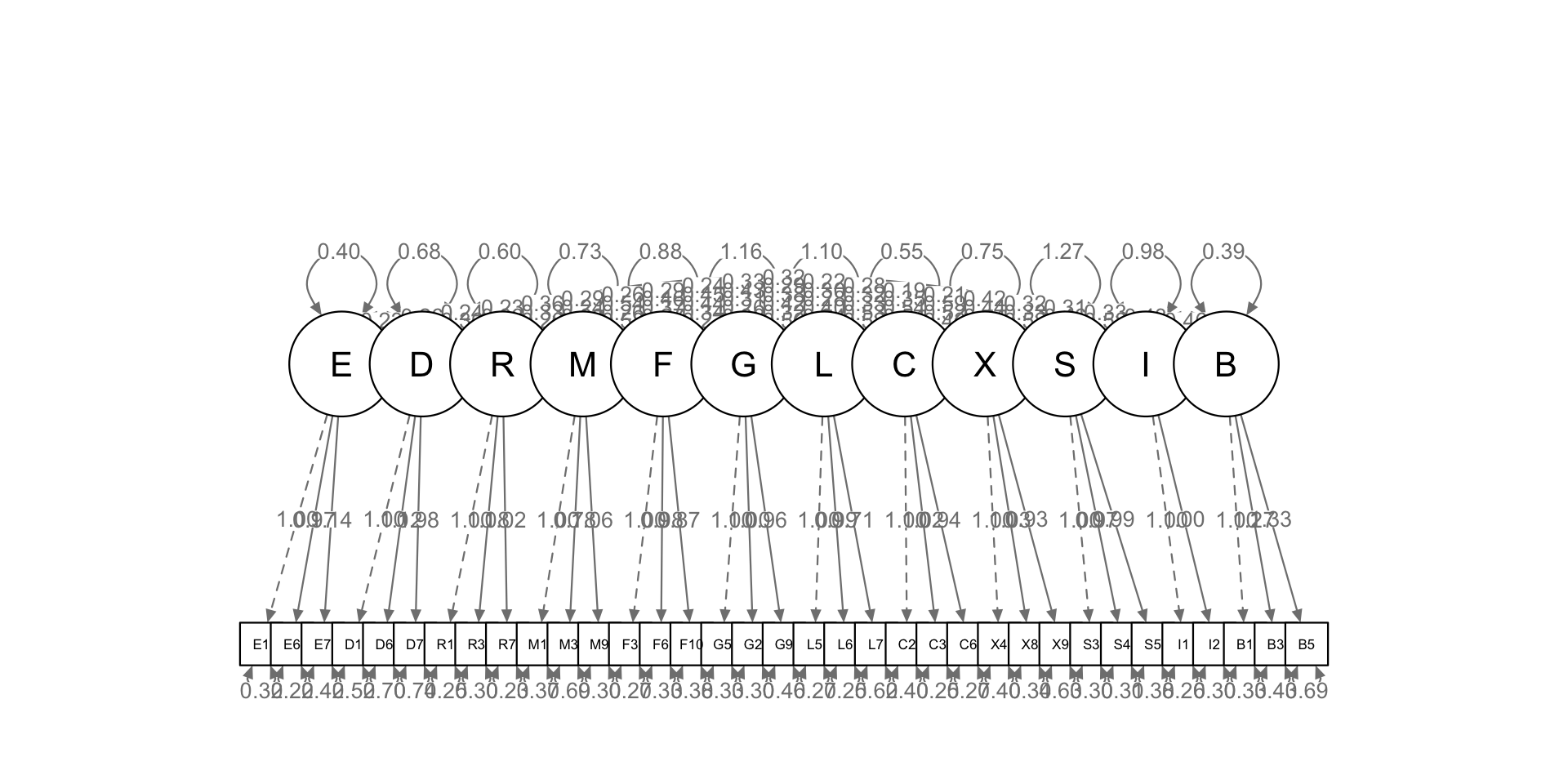
First and second-order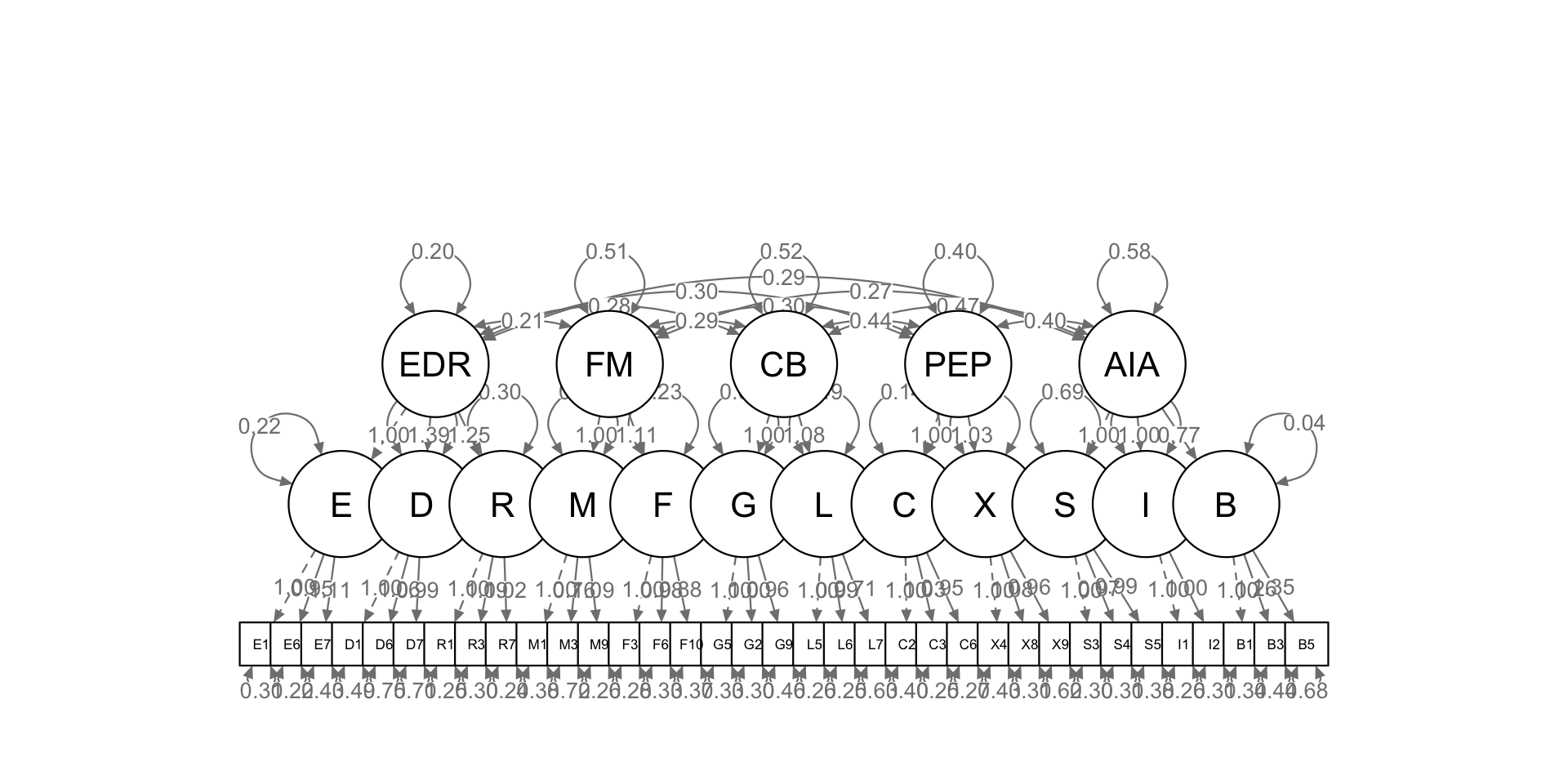
Bifactor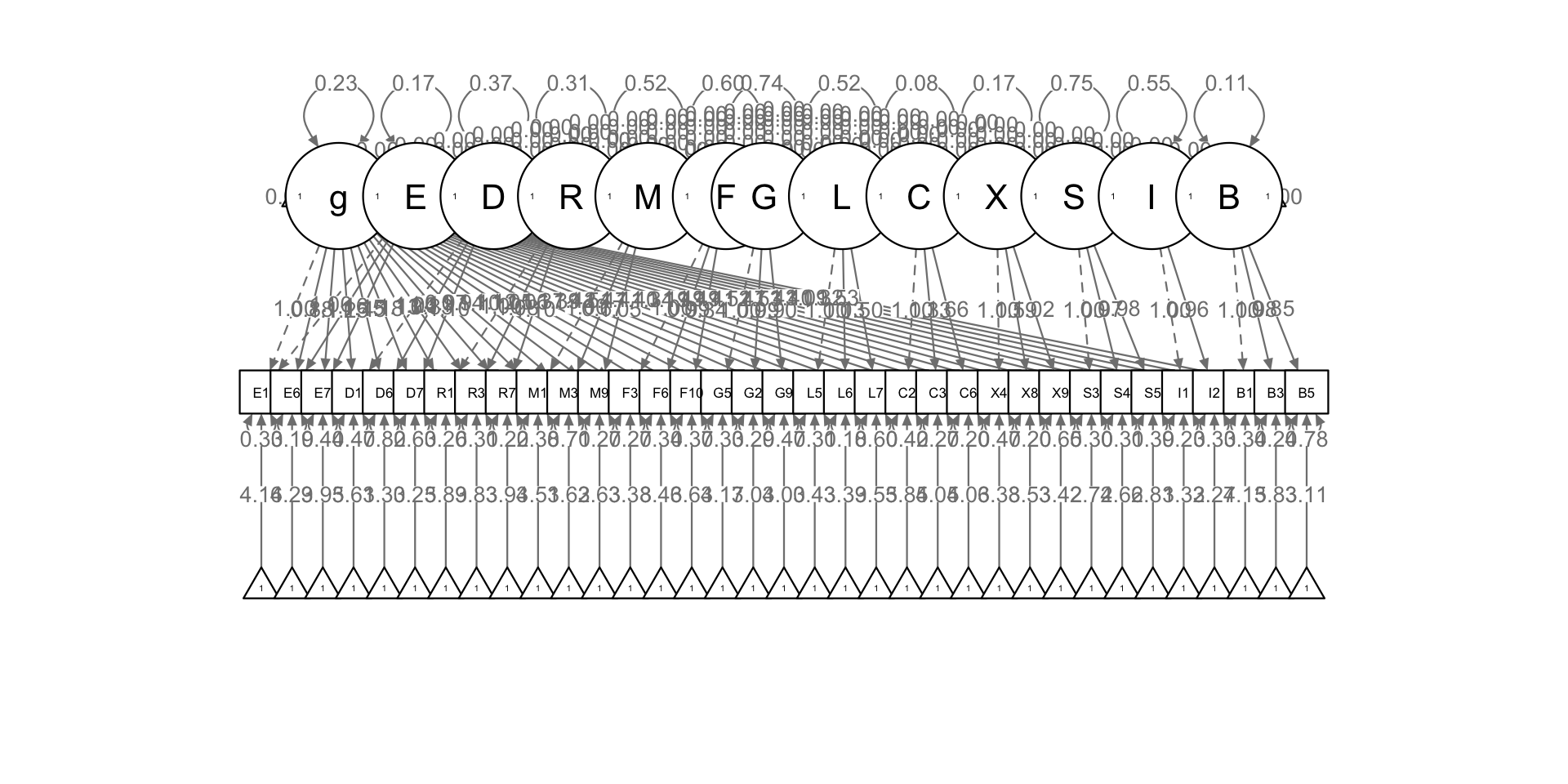
Second-order only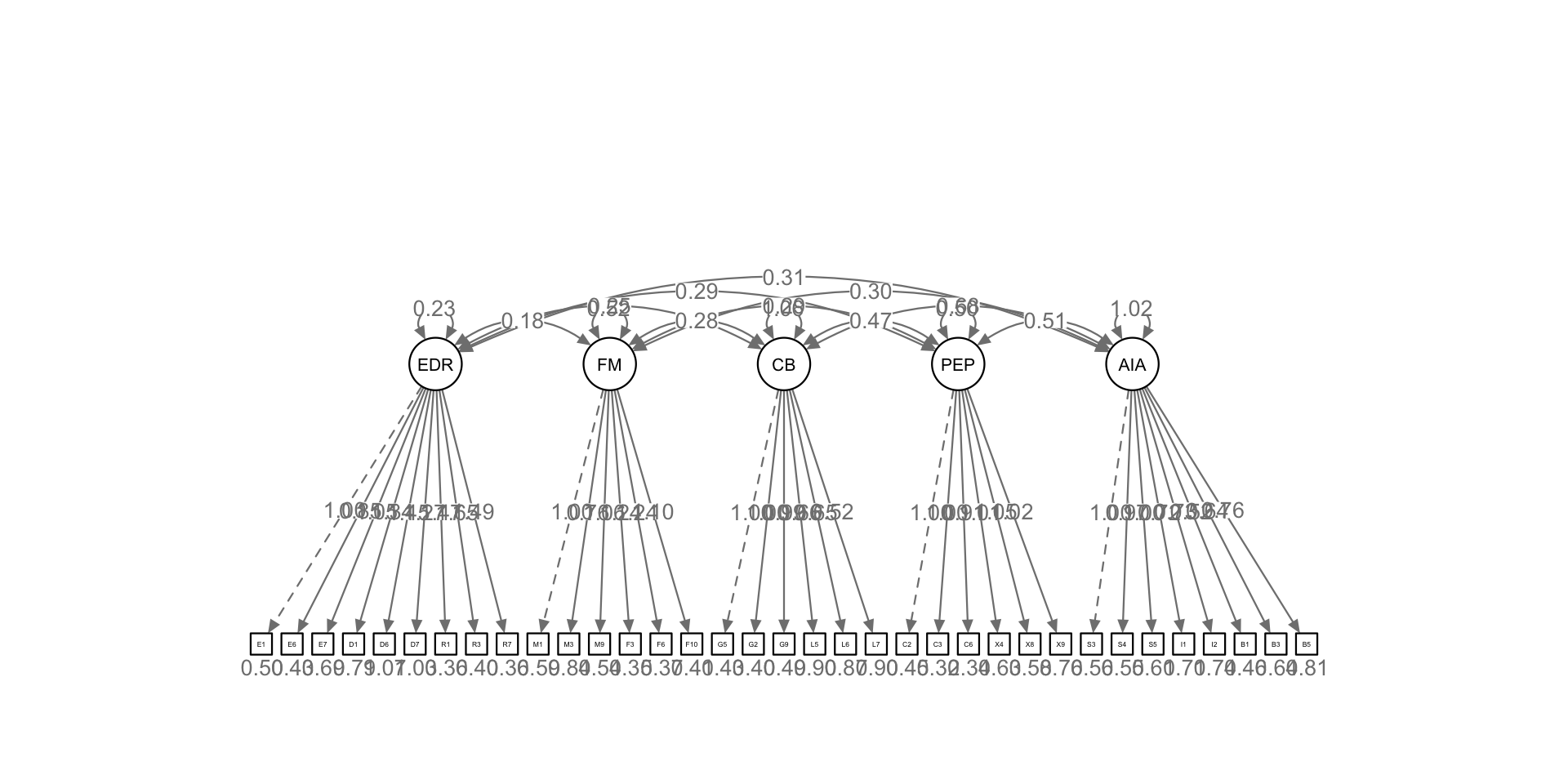
1st, 2nd, and third-order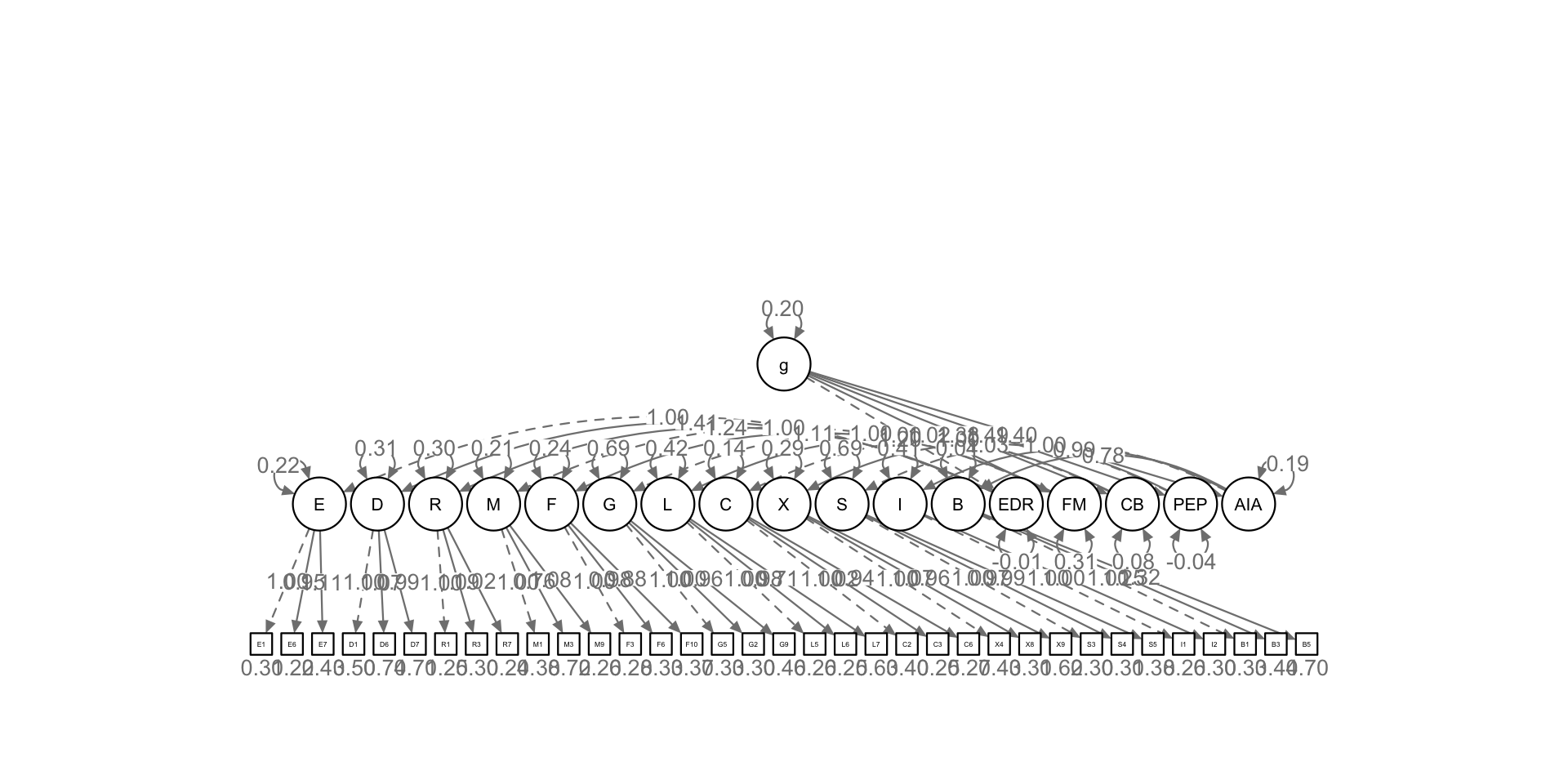
Summarise Model Fits
| tli | chisq | df | pvalue | cfi | rmsea | srmr | |
|---|---|---|---|---|---|---|---|
| 1st-order | 0.95 | 1617.75 | 494 | 0 | 0.96 | 0.04 | 0.04 |
| 1st and 2nd-order | 0.92 | 2512.25 | 538 | 0 | 0.93 | 0.06 | 0.06 |
| Bifactor | 0.90 | 2854.59 | 525 | 0 | 0.91 | 0.06 | 0.07 |
| Second-order only | 0.68 | 8516.71 | 550 | 0 | 0.70 | 0.11 | 0.10 |
| 1-,2-, 3rd-order | 0.92 | 2561.69 | 543 | 0 | 0.92 | 0.06 | 0.06 |
Compare Structures
In the manuscript, we only report first-order and second-order models, as the other candidates are significantly worse (conceptually and statistically).
o <- compareFit(fit1, fit2)
summary(o)
################### Nested Model Comparison #########################
Scaled Chi-Squared Difference Test (method = "satorra.bentler.2001")
lavaan->unknown():
lavaan NOTE: The "Chisq" column contains standard test statistics, not the
robust test that should be reported per model. A robust difference test is
a function of two standard (not robust) statistics.
Df AIC BIC Chisq Chisq diff RMSEA Df diff Pr(>Chisq)
fit1 494 98873 99743 1617.8
fit2 538 99679 100326 2512.3 689.07 0.12593 44 < 2.2e-16 ***
---
Signif. codes: 0 '***' 0.001 '**' 0.01 '*' 0.05 '.' 0.1 ' ' 1
####################### Model Fit Indices ###########################
chisq.scaled df.scaled pvalue.scaled rmsea.robust cfi.robust tli.robust
fit1 1362.501† 494 .000 .042† .961† .953†
fit2 2099.846 538 .000 .054 .930 .922
srmr aic bic
fit1 .039† 98872.698† 99743.101†
fit2 .060 99679.203 100325.643
################## Differences in Fit Indices #######################
df.scaled rmsea.robust cfi.robust tli.robust srmr aic bic
fit2 - fit1 44 0.012 -0.031 -0.031 0.021 806.505 582.541Construct Reliability (Composite Reliability)
Measure of internal consistency using omega from the second-order model.
# Calculate reliability indices:
# 0.60 questionable, 0.70 acceptable, 0.80 good, 0.90 excellent
# This is done using omega, not alpha
compRelSEM(fit1,tau.eq=F)                 # all acceptable good excellent
$E
Composite `E` is composed of observed variables:
E1, E6, E7
True-score variance is represented by common factor(s):
E
Total variance of composite `E` determined from the unrestricted model.
The proportion attributable to "true" scores is its model-based estimate of reliability ("omega"):
[1] 0.806
$D
Composite `D` is composed of observed variables:
D1, D6, D7
True-score variance is represented by common factor(s):
D
Total variance of composite `D` determined from the unrestricted model.
The proportion attributable to "true" scores is its model-based estimate of reliability ("omega"):
[1] 0.769
$R
Composite `R` is composed of observed variables:
R1, R3, R7
True-score variance is represented by common factor(s):
R
Total variance of composite `R` determined from the unrestricted model.
The proportion attributable to "true" scores is its model-based estimate of reliability ("omega"):
[1] 0.882
$M
Composite `M` is composed of observed variables:
M1, M3, M9
True-score variance is represented by common factor(s):
M
Total variance of composite `M` determined from the unrestricted model.
The proportion attributable to "true" scores is its model-based estimate of reliability ("omega"):
[1] 0.818
$F
Composite `F` is composed of observed variables:
F3, F6, F10
True-score variance is represented by common factor(s):
F
Total variance of composite `F` determined from the unrestricted model.
The proportion attributable to "true" scores is its model-based estimate of reliability ("omega"):
[1] 0.878
$G
Composite `G` is composed of observed variables:
G5, G2, G9
True-score variance is represented by common factor(s):
G
Total variance of composite `G` determined from the unrestricted model.
The proportion attributable to "true" scores is its model-based estimate of reliability ("omega"):
[1] 0.903
$L
Composite `L` is composed of observed variables:
L5, L6, L7
True-score variance is represented by common factor(s):
L
Total variance of composite `L` determined from the unrestricted model.
The proportion attributable to "true" scores is its model-based estimate of reliability ("omega"):
[1] 0.881
$C
Composite `C` is composed of observed variables:
C2, C3, C6
True-score variance is represented by common factor(s):
C
Total variance of composite `C` determined from the unrestricted model.
The proportion attributable to "true" scores is its model-based estimate of reliability ("omega"):
[1] 0.842
$X
Composite `X` is composed of observed variables:
X4, X8, X9
True-score variance is represented by common factor(s):
X
Total variance of composite `X` determined from the unrestricted model.
The proportion attributable to "true" scores is its model-based estimate of reliability ("omega"):
[1] 0.829
$S
Composite `S` is composed of observed variables:
S3, S4, S5
True-score variance is represented by common factor(s):
S
Total variance of composite `S` determined from the unrestricted model.
The proportion attributable to "true" scores is its model-based estimate of reliability ("omega"):
[1] 0.918
$I
Composite `I` is composed of observed variables:
I1, I2
True-score variance is represented by common factor(s):
I
Total variance of composite `I` determined from the unrestricted model.
The proportion attributable to "true" scores is its model-based estimate of reliability ("omega"):
[1] 0.874
$B
Composite `B` is composed of observed variables:
B1, B3, B5
True-score variance is represented by common factor(s):
B
Total variance of composite `B` determined from the unrestricted model.
The proportion attributable to "true" scores is its model-based estimate of reliability ("omega"):
[1] 0.783compRelSEM(fit2,higher = c("EDR","FM","CB","PEP","AIA"),tau.eq=F) # all acceptable good excellentWarning in compRelSEM(fit2, higher = c("EDR", "FM", "CB", "PEP", "AIA"), :
Argument higher= is deprecated. Higher-order constructs are automatically
detected by nonzero elements in the Beta matrix, and are always assumed to
represent true scores, whereas the residuals of its indicators (lower-order
factors) are considered sources of error.$E
Composite `E` is composed of observed variables:
E1, E6, E7
True-score variance is represented by common factor(s):
EDR
Total variance of composite `E` determined from the unrestricted model.
The proportion attributable to "true" scores is its model-based estimate of reliability ("omega"):
[1] 0.383
$D
Composite `D` is composed of observed variables:
D1, D6, D7
True-score variance is represented by common factor(s):
EDR
Total variance of composite `D` determined from the unrestricted model.
The proportion attributable to "true" scores is its model-based estimate of reliability ("omega"):
[1] 0.416
$R
Composite `R` is composed of observed variables:
R1, R3, R7
True-score variance is represented by common factor(s):
EDR
Total variance of composite `R` determined from the unrestricted model.
The proportion attributable to "true" scores is its model-based estimate of reliability ("omega"):
[1] 0.447
$M
Composite `M` is composed of observed variables:
M1, M3, M9
True-score variance is represented by common factor(s):
FM
Total variance of composite `M` determined from the unrestricted model.
The proportion attributable to "true" scores is its model-based estimate of reliability ("omega"):
[1] 0.577
$F
Composite `F` is composed of observed variables:
F3, F6, F10
True-score variance is represented by common factor(s):
FM
Total variance of composite `F` determined from the unrestricted model.
The proportion attributable to "true" scores is its model-based estimate of reliability ("omega"):
[1] 0.641
$G
Composite `G` is composed of observed variables:
G5, G2, G9
True-score variance is represented by common factor(s):
CB
Total variance of composite `G` determined from the unrestricted model.
The proportion attributable to "true" scores is its model-based estimate of reliability ("omega"):
[1] 0.41
$L
Composite `L` is composed of observed variables:
L5, L6, L7
True-score variance is represented by common factor(s):
CB
Total variance of composite `L` determined from the unrestricted model.
The proportion attributable to "true" scores is its model-based estimate of reliability ("omega"):
[1] 0.487
$C
Composite `C` is composed of observed variables:
C2, C3, C6
True-score variance is represented by common factor(s):
PEP
Total variance of composite `C` determined from the unrestricted model.
The proportion attributable to "true" scores is its model-based estimate of reliability ("omega"):
[1] 0.622
$X
Composite `X` is composed of observed variables:
X4, X8, X9
True-score variance is represented by common factor(s):
PEP
Total variance of composite `X` determined from the unrestricted model.
The proportion attributable to "true" scores is its model-based estimate of reliability ("omega"):
[1] 0.498
$S
Composite `S` is composed of observed variables:
S3, S4, S5
True-score variance is represented by common factor(s):
AIA
Total variance of composite `S` determined from the unrestricted model.
The proportion attributable to "true" scores is its model-based estimate of reliability ("omega"):
[1] 0.42
$I
Composite `I` is composed of observed variables:
I1, I2
True-score variance is represented by common factor(s):
AIA
Total variance of composite `I` determined from the unrestricted model.
The proportion attributable to "true" scores is its model-based estimate of reliability ("omega"):
[1] 0.516
$B
Composite `B` is composed of observed variables:
B1, B3, B5
True-score variance is represented by common factor(s):
AIA
Total variance of composite `B` determined from the unrestricted model.
The proportion attributable to "true" scores is its model-based estimate of reliability ("omega"):
[1] 0.702compRelSEM(fit3, tau.eq=F) # g good but constructs are poor $g
Composite `g` is composed of observed variables:
E1, E6, E7, D1, D6, D7, R1, R3, R7, M1, M3, M9, F3, F6, F10, G5, G2, G9, L5, L6, L7, C2, C3, C6, X4, X8, X9, S3, S4, S5, I1, I2, B1, B3, B5
True-score variance is represented by common factor(s):
g, E, D, R, M, F, G, L, C, X, S, I, B
Total variance of composite `g` determined from the unrestricted model.
The proportion attributable to "true" scores is its model-based estimate of reliability ("omega"):
[1] 0.974
$E
Composite `E` is composed of observed variables:
E1, E6, E7
True-score variance is represented by common factor(s):
g, E
Total variance of composite `E` determined from the unrestricted model.
The proportion attributable to "true" scores is its model-based estimate of reliability ("omega"):
[1] 0.803
$D
Composite `D` is composed of observed variables:
D1, D6, D7
True-score variance is represented by common factor(s):
g, D
Total variance of composite `D` determined from the unrestricted model.
The proportion attributable to "true" scores is its model-based estimate of reliability ("omega"):
[1] 0.773
$R
Composite `R` is composed of observed variables:
R1, R3, R7
True-score variance is represented by common factor(s):
g, R
Total variance of composite `R` determined from the unrestricted model.
The proportion attributable to "true" scores is its model-based estimate of reliability ("omega"):
[1] 0.882
$M
Composite `M` is composed of observed variables:
M1, M3, M9
True-score variance is represented by common factor(s):
g, M
Total variance of composite `M` determined from the unrestricted model.
The proportion attributable to "true" scores is its model-based estimate of reliability ("omega"):
[1] 0.813
$F
Composite `F` is composed of observed variables:
F3, F6, F10
True-score variance is represented by common factor(s):
g, F
Total variance of composite `F` determined from the unrestricted model.
The proportion attributable to "true" scores is its model-based estimate of reliability ("omega"):
[1] 0.879
$G
Composite `G` is composed of observed variables:
G5, G2, G9
True-score variance is represented by common factor(s):
g, G
Total variance of composite `G` determined from the unrestricted model.
The proportion attributable to "true" scores is its model-based estimate of reliability ("omega"):
[1] 0.903
$L
Composite `L` is composed of observed variables:
L5, L6, L7
True-score variance is represented by common factor(s):
g, L
Total variance of composite `L` determined from the unrestricted model.
The proportion attributable to "true" scores is its model-based estimate of reliability ("omega"):
[1] 0.881
$C
Composite `C` is composed of observed variables:
C2, C3, C6
True-score variance is represented by common factor(s):
g, C
Total variance of composite `C` determined from the unrestricted model.
The proportion attributable to "true" scores is its model-based estimate of reliability ("omega"):
[1] 0.843
$X
Composite `X` is composed of observed variables:
X4, X8, X9
True-score variance is represented by common factor(s):
g, X
Total variance of composite `X` determined from the unrestricted model.
The proportion attributable to "true" scores is its model-based estimate of reliability ("omega"):
[1] 0.832
$S
Composite `S` is composed of observed variables:
S3, S4, S5
True-score variance is represented by common factor(s):
g, S
Total variance of composite `S` determined from the unrestricted model.
The proportion attributable to "true" scores is its model-based estimate of reliability ("omega"):
[1] 0.918
$I
Composite `I` is composed of observed variables:
I1, I2
True-score variance is represented by common factor(s):
g, I
Total variance of composite `I` determined from the unrestricted model.
The proportion attributable to "true" scores is its model-based estimate of reliability ("omega"):
[1] 0.874
$B
Composite `B` is composed of observed variables:
B1, B3, B5
True-score variance is represented by common factor(s):
g, B
Total variance of composite `B` determined from the unrestricted model.
The proportion attributable to "true" scores is its model-based estimate of reliability ("omega"):
[1] 0.79compRelSEM(fit4,tau.eq=F) # all above 0.80$EDR
Composite `EDR` is composed of observed variables:
E1, E6, E7, D1, D6, D7, R1, R3, R7
True-score variance is represented by common factor(s):
EDR
Total variance of composite `EDR` determined from the unrestricted model.
The proportion attributable to "true" scores is its model-based estimate of reliability ("omega"):
[1] 0.836
$FM
Composite `FM` is composed of observed variables:
M1, M3, M9, F3, F6, F10
True-score variance is represented by common factor(s):
FM
Total variance of composite `FM` determined from the unrestricted model.
The proportion attributable to "true" scores is its model-based estimate of reliability ("omega"):
[1] 0.864
$CB
Composite `CB` is composed of observed variables:
G5, G2, G9, L5, L6, L7
True-score variance is represented by common factor(s):
CB
Total variance of composite `CB` determined from the unrestricted model.
The proportion attributable to "true" scores is its model-based estimate of reliability ("omega"):
[1] 0.833
$PEP
Composite `PEP` is composed of observed variables:
C2, C3, C6, X4, X8, X9
True-score variance is represented by common factor(s):
PEP
Total variance of composite `PEP` determined from the unrestricted model.
The proportion attributable to "true" scores is its model-based estimate of reliability ("omega"):
[1] 0.844
$AIA
Composite `AIA` is composed of observed variables:
S3, S4, S5, I1, I2, B1, B3, B5
True-score variance is represented by common factor(s):
AIA
Total variance of composite `AIA` determined from the unrestricted model.
The proportion attributable to "true" scores is its model-based estimate of reliability ("omega"):
[1] 0.886compRelSEM(fit5,tau.eq=F,higher="g") # all above 0.80Warning in compRelSEM(fit5, tau.eq = F, higher = "g"): Argument higher= is
deprecated. Higher-order constructs are automatically detected by nonzero
elements in the Beta matrix, and are always assumed to represent true scores,
whereas the residuals of its indicators (lower-order factors) are considered
sources of error.$E
Composite `E` is composed of observed variables:
E1, E6, E7
True-score variance is represented by common factor(s):
EDR
Total variance of composite `E` determined from the unrestricted model.
The proportion attributable to "true" scores is its model-based estimate of reliability ("omega"):
[1] 0.379
$D
Composite `D` is composed of observed variables:
D1, D6, D7
True-score variance is represented by common factor(s):
EDR
Total variance of composite `D` determined from the unrestricted model.
The proportion attributable to "true" scores is its model-based estimate of reliability ("omega"):
[1] 0.428
$R
Composite `R` is composed of observed variables:
R1, R3, R7
True-score variance is represented by common factor(s):
EDR
Total variance of composite `R` determined from the unrestricted model.
The proportion attributable to "true" scores is its model-based estimate of reliability ("omega"):
[1] 0.438
$M
Composite `M` is composed of observed variables:
M1, M3, M9
True-score variance is represented by common factor(s):
FM
Total variance of composite `M` determined from the unrestricted model.
The proportion attributable to "true" scores is its model-based estimate of reliability ("omega"):
[1] 0.578
$F
Composite `F` is composed of observed variables:
F3, F6, F10
True-score variance is represented by common factor(s):
FM
Total variance of composite `F` determined from the unrestricted model.
The proportion attributable to "true" scores is its model-based estimate of reliability ("omega"):
[1] 0.641
$G
Composite `G` is composed of observed variables:
G5, G2, G9
True-score variance is represented by common factor(s):
CB
Total variance of composite `G` determined from the unrestricted model.
The proportion attributable to "true" scores is its model-based estimate of reliability ("omega"):
[1] 0.367
$L
Composite `L` is composed of observed variables:
L5, L6, L7
True-score variance is represented by common factor(s):
CB
Total variance of composite `L` determined from the unrestricted model.
The proportion attributable to "true" scores is its model-based estimate of reliability ("omega"):
[1] 0.545
$C
Composite `C` is composed of observed variables:
C2, C3, C6
True-score variance is represented by common factor(s):
PEP
Total variance of composite `C` determined from the unrestricted model.
The proportion attributable to "true" scores is its model-based estimate of reliability ("omega"):
[1] 0.621
$X
Composite `X` is composed of observed variables:
X4, X8, X9
True-score variance is represented by common factor(s):
PEP
Total variance of composite `X` determined from the unrestricted model.
The proportion attributable to "true" scores is its model-based estimate of reliability ("omega"):
[1] 0.5
$S
Composite `S` is composed of observed variables:
S3, S4, S5
True-score variance is represented by common factor(s):
AIA
Total variance of composite `S` determined from the unrestricted model.
The proportion attributable to "true" scores is its model-based estimate of reliability ("omega"):
[1] 0.424
$I
Composite `I` is composed of observed variables:
I1, I2
True-score variance is represented by common factor(s):
AIA
Total variance of composite `I` determined from the unrestricted model.
The proportion attributable to "true" scores is its model-based estimate of reliability ("omega"):
[1] 0.512
$B
Composite `B` is composed of observed variables:
B1, B3, B5
True-score variance is represented by common factor(s):
AIA
Total variance of composite `B` determined from the unrestricted model.
The proportion attributable to "true" scores is its model-based estimate of reliability ("omega"):
[1] 0.698cor_matrix <- lavInspect(fit2, "cor.lv")
print(knitr::kable(cor_matrix,digits=2,caption="Correlations between the latent factors (for sub-constructs and constructs)."))
Table: Correlations between the latent factors (for sub-constructs and constructs).

|    |    E|    D|    R|    M|    F|    G|    L|    C|    X|    S|    I|    B|  EDR|   FM|   CB|  PEP|  AIA|
|:---|----:|----:|----:|----:|----:|----:|----:|----:|----:|----:|----:|----:|----:|----:|----:|----:|----:|
|E   | 1.00| 0.51| 0.49| 0.39| 0.39| 0.40| 0.44| 0.64| 0.57| 0.40| 0.45| 0.56| 0.69| 0.46| 0.59| 0.74| 0.59|
|D   | 0.51| 1.00| 0.52| 0.41| 0.42| 0.43| 0.47| 0.68| 0.61| 0.42| 0.48| 0.59| 0.73| 0.49| 0.63| 0.79| 0.62|
|R   | 0.49| 0.52| 1.00| 0.40| 0.40| 0.41| 0.46| 0.66| 0.59| 0.41| 0.47| 0.57| 0.71| 0.47| 0.61| 0.76| 0.61|
|M   | 0.39| 0.41| 0.40| 1.00| 0.72| 0.32| 0.35| 0.49| 0.44| 0.28| 0.32| 0.39| 0.56| 0.84| 0.47| 0.57| 0.41|
|F   | 0.39| 0.42| 0.40| 0.72| 1.00| 0.32| 0.36| 0.49| 0.44| 0.28| 0.32| 0.40| 0.57| 0.85| 0.48| 0.57| 0.42|
|G   | 0.40| 0.43| 0.41| 0.32| 0.32| 1.00| 0.50| 0.56| 0.51| 0.38| 0.44| 0.54| 0.58| 0.38| 0.67| 0.65| 0.57|
|L   | 0.44| 0.47| 0.46| 0.35| 0.36| 0.50| 1.00| 0.62| 0.56| 0.43| 0.48| 0.60| 0.64| 0.42| 0.74| 0.72| 0.63|
|C   | 0.64| 0.68| 0.66| 0.49| 0.49| 0.56| 0.62| 1.00| 0.67| 0.48| 0.55| 0.68| 0.92| 0.58| 0.83| 0.86| 0.72|
|X   | 0.57| 0.61| 0.59| 0.44| 0.44| 0.51| 0.56| 0.67| 1.00| 0.44| 0.49| 0.61| 0.83| 0.52| 0.75| 0.77| 0.64|
|S   | 0.40| 0.42| 0.41| 0.28| 0.28| 0.38| 0.43| 0.48| 0.44| 1.00| 0.52| 0.64| 0.58| 0.33| 0.57| 0.56| 0.68|
|I   | 0.45| 0.48| 0.47| 0.32| 0.32| 0.44| 0.48| 0.55| 0.49| 0.52| 1.00| 0.73| 0.65| 0.38| 0.65| 0.64| 0.77|
|B   | 0.56| 0.59| 0.57| 0.39| 0.40| 0.54| 0.60| 0.68| 0.61| 0.64| 0.73| 1.00| 0.81| 0.46| 0.80| 0.79| 0.95|
|EDR | 0.69| 0.73| 0.71| 0.56| 0.57| 0.58| 0.64| 0.92| 0.83| 0.58| 0.65| 0.81| 1.00| 0.66| 0.86| 1.07| 0.85|
|FM  | 0.46| 0.49| 0.47| 0.84| 0.85| 0.38| 0.42| 0.58| 0.52| 0.33| 0.38| 0.46| 0.66| 1.00| 0.56| 0.67| 0.49|
|CB  | 0.59| 0.63| 0.61| 0.47| 0.48| 0.67| 0.74| 0.83| 0.75| 0.57| 0.65| 0.80| 0.86| 0.56| 1.00| 0.97| 0.84|
|PEP | 0.74| 0.79| 0.76| 0.57| 0.57| 0.65| 0.72| 0.86| 0.77| 0.56| 0.64| 0.79| 1.07| 0.67| 0.97| 1.00| 0.83|
|AIA | 0.59| 0.62| 0.61| 0.41| 0.42| 0.57| 0.63| 0.72| 0.64| 0.68| 0.77| 0.95| 0.85| 0.49| 0.84| 0.83| 1.00|
Redo with Confidence Intervals using bootstrapping
first_order <- "
# sub-factors: EDR
E =~ E1 + E6 + E7
D =~ D1 + D6 + D7
R =~ R1 + R3 + R7

# sub-factors: FM
M =~ M1 + M3 + M9
F =~ F3 + F6 + F10

# sub-factors: CB
G =~ G5 + G2 + G9
L =~ L5 + L6 + L7

# sub-factors: PEP
C =~ C2 + C3 + C6
X =~ X4 + X8 + X9

# sub-factors: AIA
S =~ S3 + S4 + S5
I =~ I1 + I2
B =~ B1 + B3 + B5
"

items <- c("E1","E6","E7","D1","D6","D7","R1","R3","R7","M1","M3","M9","F3","F6","F10","G5","G2","G9","L5","L6","L7","C2","C3","C6","X4","X8","X9","S3","S4","S5","I1","I2","B1","B3","B5")
tmp <- CFA_items(df_f,vignette = 1:12, items=items,vignette_name="ALL",bonusquestion="HAAS")
fit1 <- lavaan::cfa(model = first_order, data = tmp, meanstructure = TRUE,estimator = "MLR")


library(lavaan)
library(semTools)
library(boot)
Attaching package: 'boot'The following object is masked from 'package:psych':
logitomega_fun <- function(fit) {
out <- semTools::compRelSEM(
fit,
tau.eq = FALSE
)
as.numeric(out)
}
set.seed(1208)
boot_omega <- lavaan::bootstrapLavaan(
fit1,
R = 2000,
parallel = "snow",
verbose = TRUE,
FUN = omega_fun
)omega <- semTools::compRelSEM(
fit1,
tau.eq = FALSE
)
ci <- apply(
boot_omega,
2,
quantile,
probs = c(.025, .975),
na.rm = TRUE
)
results <- data.frame(
factor = names(omega),
omega = as.numeric(omega),
lower = ci[1, ],
upper = ci[2, ]
)
print(knitr::kable(results,digits = 3,caption="Composite Reliability (Omega) with 95% Confidence Intervals."))| factor | omega | lower | upper |
|---|---|---|---|
| E | 0.806 | 0.778 | 0.830 |
| D | 0.769 | 0.739 | 0.794 |
| R | 0.882 | 0.865 | 0.896 |
| M | 0.818 | 0.797 | 0.837 |
| F | 0.878 | 0.863 | 0.893 |
| G | 0.903 | 0.891 | 0.915 |
| L | 0.881 | 0.867 | 0.894 |
| C | 0.842 | 0.819 | 0.863 |
| X | 0.829 | 0.808 | 0.848 |
| S | 0.918 | 0.908 | 0.928 |
| I | 0.874 | 0.854 | 0.893 |
| B | 0.783 | 0.761 | 0.804 |
Discriminant Validity
Average Variance Explained (traditional)
Measure of discriminant validity from the first-order model.
# calculate average variance explained, 0.50+ is acceptable
lavInspect(fit1, "cor.lv")
E D R M F G L C X S I B
E 1.000
D 0.432 1.000
R 0.518 0.555 1.000
M 0.449 0.467 0.300 1.000
F 0.381 0.429 0.409 0.724 1.000
G 0.521 0.271 0.306 0.298 0.270 1.000
L 0.432 0.623 0.450 0.381 0.390 0.502 1.000
C 0.559 0.747 0.760 0.410 0.462 0.431 0.668 1.000
X 0.535 0.635 0.467 0.565 0.491 0.574 0.595 0.667 1.000
S 0.337 0.459 0.428 0.295 0.313 0.445 0.438 0.524 0.531 1.000
I 0.529 0.361 0.389 0.374 0.375 0.553 0.429 0.454 0.533 0.517 1.000
B 0.807 0.428 0.579 0.353 0.357 0.620 0.484 0.678 0.608 0.612 0.748 1.000# First-order model
AVE(fit1) # all above 0.50 E D R M F G L C X S I B
0.579 0.528 0.713 0.596 0.708 0.756 0.704 0.636 0.615 0.789 0.776 0.541 # First and second-order
AVE(fit2) # all above 0.50 E D R M F G L C X S I B
0.577 0.528 0.713 0.594 0.708 0.756 0.704 0.635 0.617 0.789 0.776 0.541 # Bifactor
AVE(fit3,omit.factors="g") # All below 0.50 E D R M F G L C X S I B
0.277 0.259 0.380 0.394 0.475 0.462 0.339 0.184 0.222 0.464 0.420 0.196 # Second-order only
AVE(fit4) # FM, CB and AIA above 0.50, EDR and PEP below 0.50 EDR FM CB PEP AIA
0.383 0.539 0.520 0.493 0.513 # 1st, 2nd, and third-order
AVE(fit5) # all above 0.50 E D R M F G L C X S I B
0.577 0.529 0.713 0.594 0.708 0.756 0.704 0.636 0.617 0.789 0.776 0.540 Discriminant Validity with HTMT
Let’s use the modern Heterotrait–Monotrait Ratio (HTMT) method to assess discriminant validity. It uses ratio of the correlations (Henseler, Ringlet & Sarstedt, 2015).
All Sub-constructs (first-order model)
htmt_matrix <- htmt(first_order,data = tmp,htmt2 = FALSE)
print(knitr::kable(htmt_matrix,digits=3,caption='Discriminant Validity at the level of Sub-Constructs.'))| E | D | R | M | F | G | L | C | X | S | I | B | |
|---|---|---|---|---|---|---|---|---|---|---|---|---|
| E | 1.000 | 0.443 | 0.521 | 0.515 | 0.396 | 0.525 | 0.463 | 0.563 | 0.542 | 0.338 | 0.528 | 0.809 |
| D | 0.443 | 1.000 | 0.552 | 0.459 | 0.426 | 0.276 | 0.654 | 0.745 | 0.654 | 0.458 | 0.358 | 0.431 |
| R | 0.521 | 0.552 | 1.000 | 0.272 | 0.405 | 0.309 | 0.494 | 0.760 | 0.474 | 0.429 | 0.388 | 0.577 |
| M | 0.515 | 0.459 | 0.272 | 1.000 | 0.721 | 0.346 | 0.424 | 0.401 | 0.597 | 0.299 | 0.405 | 0.394 |
| F | 0.396 | 0.426 | 0.405 | 0.721 | 1.000 | 0.280 | 0.444 | 0.464 | 0.497 | 0.315 | 0.379 | 0.367 |
| G | 0.525 | 0.276 | 0.309 | 0.346 | 0.280 | 1.000 | 0.514 | 0.432 | 0.568 | 0.451 | 0.552 | 0.633 |
| L | 0.463 | 0.654 | 0.494 | 0.424 | 0.444 | 0.514 | 1.000 | 0.714 | 0.631 | 0.472 | 0.460 | 0.517 |
| C | 0.563 | 0.745 | 0.760 | 0.401 | 0.464 | 0.432 | 0.714 | 1.000 | 0.682 | 0.534 | 0.459 | 0.688 |
| X | 0.542 | 0.654 | 0.474 | 0.597 | 0.497 | 0.568 | 0.631 | 0.682 | 1.000 | 0.532 | 0.536 | 0.619 |
| S | 0.338 | 0.458 | 0.429 | 0.299 | 0.315 | 0.451 | 0.472 | 0.534 | 0.532 | 1.000 | 0.517 | 0.618 |
| I | 0.528 | 0.358 | 0.388 | 0.405 | 0.379 | 0.552 | 0.460 | 0.459 | 0.536 | 0.517 | 1.000 | 0.758 |
| B | 0.809 | 0.431 | 0.577 | 0.394 | 0.367 | 0.633 | 0.517 | 0.688 | 0.619 | 0.618 | 0.758 | 1.000 |
diag(htmt_matrix)=NA
round(min(htmt_matrix,na.rm=TRUE),3)
[1] 0.272
round(max(htmt_matrix,na.rm=TRUE),3)[1] 0.809
round(median(htmt_matrix,na.rm=TRUE),3)[1] 0.484
All Constructs (second-order model)
htmt_matrix <- htmt(episodes,data = tmp,htmt2 = FALSE)
print(knitr::kable(htmt_matrix,digits=3,caption='Discriminant Validity at the level of Constructs.'))| EDR | FM | CB | PEP | AIA | |
|---|---|---|---|---|---|
| EDR | 1.000 | 0.565 | 0.672 | 0.871 | 0.712 |
| FM | 0.565 | 1.000 | 0.484 | 0.596 | 0.459 |
| CB | 0.672 | 0.484 | 1.000 | 0.771 | 0.719 |
| PEP | 0.871 | 0.596 | 0.771 | 1.000 | 0.740 |
| AIA | 0.712 | 0.459 | 0.719 | 0.740 | 1.000 |
diag(htmt_matrix)=NA
round(min(htmt_matrix,na.rm=TRUE),3)
[1] 0.459
round(max(htmt_matrix,na.rm=TRUE),3)[1] 0.871
round(median(htmt_matrix,na.rm=TRUE),3)[1] 0.692