
Why Context Matters in Music and Emotions
The same song, different emotions
Imagine hearing your favourite song performed live by your favourite artist. The lights dim, the riff begins, and the crowd erupts. The music feels powerful, immersive—perhaps even overwhelming. Now imagine hearing the same song a week later while doing your weekly a shopping at a supermarket.
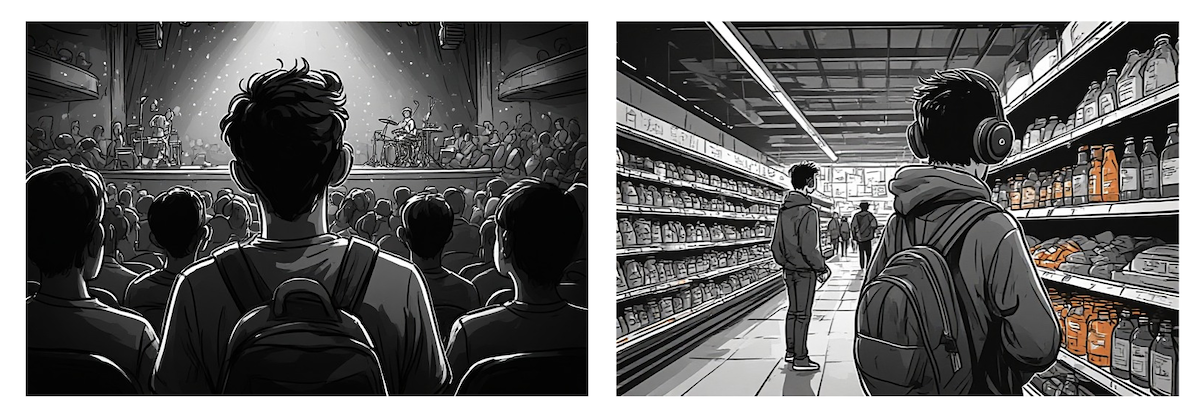
The music has not changed. But your experience of it has.
This simple observation reveals something important about how music affects us. The emotions we feel when listening to music are not determined by the music alone. They depend strongly on the situation in which the music occurs and what is the function of the music in that situation.
Music at a concert can feel exhilarating. The same music in the background of a café may help you concentrate. During a workout, it may boost your energy. In another context, it may simply fade into the background.
So what exactly is happening here?
A gap in music–emotion research
For many years, research on music and emotion has largely focused on two basic questions: how does music trigger emotions, and what are these emotions?
Researchers have proposed several mechanisms—such as rhythmic entrainment, conditioned memories, and emotional contagion—to explain how music can evoke emotional responses (Juslin, 2019). Musical features such as tempo, loudness, or harmony have then been linked to either a small set of basic emotions, including happiness, sadness, anger, and fear (Eerola, Friberg & Bresin, 2013) or a more music-grounded richer vocabulary of emotion dimensions from nostalgia to wonder and joy (as in Geneva Emotion Musical scale by Zentner et al. (2008).
At the same time, another research tradition has examined how people use music to regulate their moods in everyday life (Saarikallio et al., 2017).
Surprisingly, these two areas of research have often developed separately, even though they are clearly related. One focuses on emotional responses to music, while the other focuses on the functions music serves in daily life. This separation raises an important question: are we missing something central by studying emotions and musical functions independently? Also, if we are linking musical content and emotions, are these more or less important for emotions than the functions and situations?
A new way of thinking about emotions
Part of the difficulty lies in how emotions themselves are conceptualised. Traditional approaches often assume that emotions are relatively fixed categories that can be reliably triggered by particular stimuli. However, growing evidence suggests that emotional experiences are far more context-dependent than this view implies. Studies have struggled to find consistent patterns linking musical features, emotional experiences, and neural responses.
This has led many researchers to adapt constructionist theories of emotion, strongly associated with the work of Lisa Feldman Barrett (Barrett, 2017). In this view, emotions are not simply triggered by stimuli. Instead, they are constructed by individuals in specific situations, drawing on context, prior experience, goals, and interpretation.
If this perspective is correct, then the emotional impact of music cannot be understood by looking at the music alone. We must also consider what the listener is doing, why they are listening, and what role the music plays in that moment. If emotions are constructed within situations, then understanding music and emotion requires understanding the situations in which people listen to music. So, instead of focussing on music or the emotions experienced by the music, it might be more fruitful to focus on meaningful situations in which music is used in everyday life.
Typical emotional episodes with music
In our research, we try to capture this idea by focusing on emotional episodes with music, which is a term that describes the situations in which music is used in everyday life. To better understand how music creates emotional experiences, we developed what we call the episode model (Eerola et al., 2025). The key idea is simple: the situation, function, and context of listening are the primary drivers of musical experience, rather than the acoustic features of the music alone.
We developed this framework by combining insights from cross-cultural research on the functions of music with real-world evidence from experience sampling studies, in which people report their musical experiences as they occur in daily life. Imagine listening to music while studying, running, celebrating with friends, or reflecting after a difficult day. In each of these situations, music serves a different purpose.
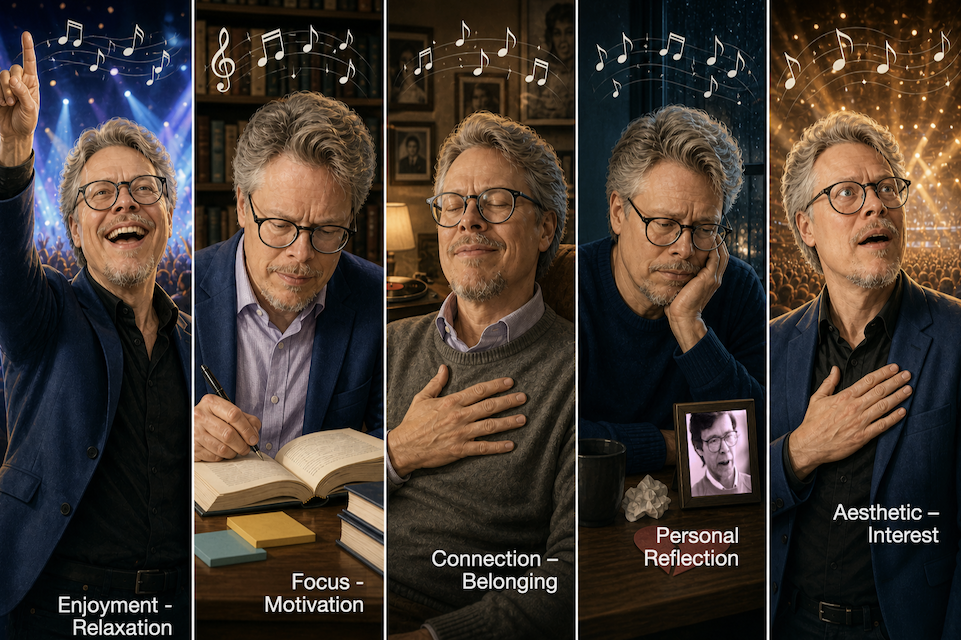
Across everyday listening situations, these experiences tend to cluster into a small number of recurring patterns. Our episode model captures five broad types of musical episodes:
- Enjoyment / Relaxation: Music is used for pleasure, relaxation, or light distraction.
- Focus / Motivation: Music supports concentration (e.g., studying) or enhances energy and drive (e.g., during exercise).
- Connection / Belonging: Music facilitates social connection, shared experiences, or a sense of belonging.
- Personal Reflection: Music is used to reflect on personal issues, process emotions, and construct meaning.
- Aesthetic Interest / Awe: Music elicits aesthetic appreciation, intellectual engagement, and occasionally moments of awe or being deeply moved.
These episodes describe the broad types of functions in which people commonly use music and the roles music plays in those moments.
Turning the framework into a research tool
Of course, a framework is only useful if it can be studied empirically. Over the past two years, we have worked on developing tools that allow researchers to measure these musical episodes systematically.
The first step was to create an instrument that captures the episodes themselves. Connor Kirts began by compiling hundreds of items from existing questionnaires about the functions of music. Items in this case are statements about functions of music in a given situation (e.g., “I was using the music to relax” or “the music was comforting to me”). We then asked 14 experts in music and emotions to evaluate whether these items adequately reflected the different concepts in the framework. This gave us the best matching and consensus items for each construct (Kirts et al., 2026). This process allowed us to refine the list and reduce it to a manageable set while preserving its theoretical foundations.
Next, we tested the instrument in a series of studies. Participants were asked to imagine specific listening scenarios—for example, exercising, studying, or reflecting after a difficult day—and to indicate how well the episode-related items described the situation. This process resulted in a relatively concise 35-item questionnaire that captures five distinct types of musical episodes (Kirts et al., 2026).
In the same studies, we also measured emotional experiences and related variables, allowing us to examine how episodes and emotions are linked. The patterns are now fairly clear: enjoyment and relaxation episodes tend to be associated with joy and calm; focus and motivation episodes with feelings of inspiration, energy, and power; and connection and belonging episodes with nostalgia and tenderness. Personal emotional processing is typically characterised by a more melancholic tone, whereas aesthetic experiences revolve around being moved, amazed, or filled with wonder.
Rethinking music and emotion
Ultimately, this approach suggests a shift in how we study music and emotion. Instead of asking which musical features trigger specific emotions and what are the underlying mechanisms, we might ask a different question:
How do people use music to shape their emotional experiences in different situations?
By focusing on the episodes, we can begin to understand how music functions in the flow of everyday life—helping people concentrate, connect with others, process emotions, or experience moments of aesthetic wonder. Music does not merely trigger emotions; it becomes part of the context in which emotional experience is constructed. In other words, music is not just something we feel. It is something we use to shape how we feel.
References
-
Barrett, L. F. (2017). How emotions are made: The secret life of the brain. Houghton Mifflin Harcourt.
-
Eerola, T., Kirts, C., & Saarikallio, S. H. (2025). Episode model: The functional approach to emotional experiences of music. Psychology of Music, 53(4), 590–615. https://doi.org/10.1177/03057356241279763
-
Eerola, T., Friberg, A., & Bresin, R. (2013). Emotional Expression in Music: Contribution, Linearity, and Additivity of Primary Musical Cues. Frontiers in Psychology, 4(487). http://www.frontiersin.org/emotion_science/10.3389/fpsyg.2013.00487/
-
Juslin, P. N. (2019). Musical emotions explained: Unlocking the secrets of musical affect. Oxford University Press, USA.
-
Kirts, C., Saarikallio, S., Anderson, C. J., Bannister, S., Céspedes-Guevara, J., Heng, G. J., Henry, N., Jakubowski, K., Koehler, F., Krause, A. E., Lennie, T. M., Martı́nez, I. C., O’Neill, K., Warrenburg, L., & Eerola, T. (2026). Measuring emotional experiences with music – content validity assessment for episode model constructs. Music & Science. https://doi.org/10.1177/20592043251413550
-
Kirts, C., Saarikallio, S., & Eerola, T. (2026). Measure of emotional episodes with music (MEEM): Development and psychometric evaluation of a modular instrument. preprint. https://doi.org/10.31234/osf.io/h43ac_v1
-
Saarikallio, S. H., Baltazar, M., & Västfjäll, D. (2017). Adolescents’ musical relaxation: Understanding related affective processing. Nordic Journal of Music Therapy, 26(4), 376–389. https://doi.org/10.1080/08098131.2016.1276097
-
Zentner, M., Grandjean, D., & Scherer, K. R. (2008). Emotions evoked by the sound of music: Characterization, classification, and measurement. Emotion, 8(4), 494–521. https://doi.org/10.1037/1528-3542.8.4.494